
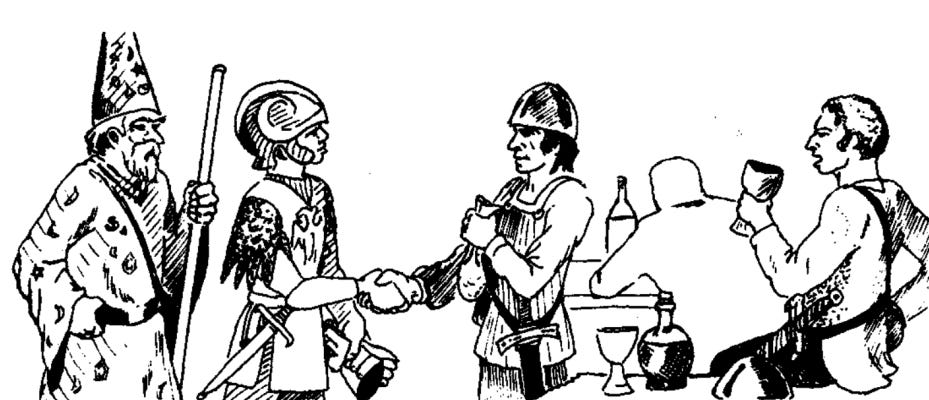
(Image from Module “In Search of the Unknown”)
Hello all,
Once again I am writing due to inspiration from Knavelands who recently ruminated on a lack of explicit settlement procedures in Knave (while drawing attention to implicit ones.) I’ve also been thinking about this lately as I’ve been writing small rules addendums to Knave and figured I would share some of my procedures. This will follow in three parts: Part I lays out the rules for Settlement procedures, Part II gives a frame work for rolling rumors, and Part III is some developer’s commentary on both.
PART I
SETTLEMENTS
WATCHES: While in settlements and safe havens, days are divided into six four-hour watches: three for day, three for night. Most major actions (shopping, visiting locations, interacting, etc.) take one watch to complete.
SETTLEMENT SPEED: In a settlement, PCs can move to any location within the settlement and complete one activity in a watch.
NAVIGATION: If the settlement is dangerous to the PCs (PCs are outlaws, gangs are after PCs, etc.) travel between locations could instead utilize the Delving rules and movement speeds if needed (p. 13).
EXPLORING: The party can spend a watch exploring a street to reveal any areas of interest (alleys, hideouts, ruins, etc.) that wouldn’t be noticed by passing through.
SECRET FEATURES: Secret features (such as hideouts) should have corresponding clues revealed by exploring the area. They are only found by the PCs interacting with the world.
RUMORS: A PC can spend 1d6 x 10 coins and one watch at a local tavern (buying rounds, slipping the barman coins, etc.) to learn the goings on in the town or region.
SPECIFIC RUMORS: If a PC wishes to ask about a specific rumor/info they make a CHA check alongside the coin spent. Be wary that asking around can become a rumor itself!
THE SETTLEMENT EVENT DIE: At the end of each watch, roll the Settlement Event Die and apply the result. Safely sleeping PCs (house, private room, etc.) treat all results as “Free” except 3 and 4.
D6 SETTLEMENT EVENT DIE RESULTS
ENCOUNTER: The party has an encounter, usually rolled from a table designed for the settlement. The GM determines the encounter’s reaction, activity, distance from the party, and if they are surprised (p. 19).
MISSION: The PCs are approached to complete a mission (p. 51) or the state of a current mission changes.
DEPLETION: Roll a d6 for each perishable item (rations, monster parts, etc.). On a 1 it has gone bad.
SETTLEMENT SHIFT: The weather changes (p. 9) or a local event begins (city events, p. 46).
SIGN: The PCs overhear a rumor the GM creates or rolls from a table.
FREE: No effect.
GUARDS: 3d6 appear in d6 rounds if called.
NPC ITEMS: d20c and d2 Misc. Items (p. 39)
PART II
RUMORS
A PC can spend 1d6 x 10 coins and one watch at a local tavern (buying rounds, slipping the barman coins, etc.) to learn about what is going on in the settlement or region.
SPECIFIC RUMORS: If a PC wishes to ask about a specific rumor/info they make a CHA check alongside the coin spent. On a success, the PC learns about the specific subject. On a failure, the GM makes a standard rumor roll. There is a 4-in-6 chance the PCs asking for the information becomes a new rumor.
Roll d12
1-2: MISSION: The PCs learn about a mission (p. 51) or event by overhearing someone talk about it. If a mission or event is already in progress, the rumor is a clue or relevant fact.
3: WORLD: Chose a far-off culture or region and describe something about it. If this is a false rumor, the Tome of Worldbuilding (p. 36) by Matt Finch can provide inspiration for outlandish tales.
4: WILDERNESS: Roll a hex in the region and describe it on a very surface level, including its location. Do not reveal secrets.
5: SETTLEMENT: Choose an interesting fact, building, or location in the settlement to reveal to the PCs. For example, a home that has a dungeon entrance or holds a secret society.
6: FALSE RUMOR (Reroll for type)
7: NO RUMOR
8: ROLL TWICE
9: NPC: Chose an NPC from the settlement and reveal information about them. In a pinch, it’s the town leader or a local faction.
10: ENCOUNTER: Roll an encounter and foreshadow it. The next time the PCs have an encounter, it’s this one. 1-in-6 chance this is a wilderness encounter instead of a settlement encounter.
11: MONSTER INFO: Roll or choose a monster (p. 61 ) or an entry from your preferred bestiary (such as The Monster Overhaul) and describe one fact about it.
12: DUNGEON/ADVENTURE SITE: Roll a wilderness hex in the region and describe a detail about it. Also reveal the sites location.
(Roll d6) 1-2: Inhabitants 3-4: Treasure 5-6: Trap/Hazards
PART III
DEVELOPER’S COMMENTARY
I liked the Knave travel rules and I figured they’d work for towns as well. Instead of tracking granular movement at all times ala City State of the Invincible Overlord or AD&D, I instead opted to abstract the day into 4 main “activities” (since presumably two watches will be spent sleeping most nights). This sets a limit on PC activity per day that doesn’t require counting squares to go equipment shopping but is less extreme than only having one action per day in town.
As with the travel rules, the lynchpin of the settlement procedure is the hazard die, renamed here to the “event” die given the mundane environment of a town. Most results are familiar and resemble the travel hazard die, which allows continuity with wilderness travel rules by allowing weather to still change and impact settlement play, perishables to still go bad, encounters to still occur, etc. The primary alterations are the replacement of a “fatigue” result with a mission result and “sign” resulting in a rumor. A list of missions should probably be created before play begins akin to a random encounter table, but one could create the details on the fly. The mission result could also move a mission forward, such as a killer striking again or what have you.
Missions and rumors come naturally to PCs in Empire of the Petal Throne and Traveller and figured it would be a good fit here as well. This led me to create a d12 table for creating rumors. I have written the Settlements rules to be player facing, but I don’t believe the rumor-making table necessarily needs to be.
For settlement encounters, I set them up as per the Knave Encounters rules (using the dungeon encounter distance, activities, reaction, etc.). As a bonus I will include some random encounter tables using entries from Skerples’ Monster Overhaul below.
SETTLEMENT ENCOUNTERS
Roll on the table below and for Person Type as needed.
2d6 SETTLEMENT ENCOUNTERS
2 Adventurer (p. 12)
3 Knight (p. 21)
4 Mercenary (p. 27) or Pirate (p. 273)
5 Guard (Mercenary) (p. 27)
6 Townsfolk (p. 33)
7 Peasant (p. 30)
8 Roll Twice on this table
9 Animal (p. 64)*
10 Merchant (p. 27)
11 Pilgrim (p. 29)
12 Roll Oddity
d6 ODDITY
1 Barbarian (p. 17)
2 Cultist (p. 19)
3 Monster (p. 61)*
4 Monster Overhaul Table of Contents*
5 Visionary (p. 154)
6 Wizard (p. 35)
*Reroll nonsensical results. If the same result is rolled twice, strongly consider using it anyway.d6 PERSON TYPE
1-4 Local Human
5 Foreign Human
6 Roll Non-Human Type
d4 NON-HUMAN TYPE
1 Dwarf
2 Elf
3 Gnome
4 Roll Other Non-Humans
d6 OTHER NON-HUMANS
1-3 Half- (Roll d3 above)
4-6 Animal (p. 64) Person2d6 RANDOM AGE (If needed/desired)
2 Child
3-5 Teenager
6-8 Young Adult
9-11 Adult
12 Elder
As for creating settlements, that is probably best tackled in another post. To touch on this briefly I will say some good resources and references for this are Wilderness Hexplore (which can be tricky to find the PDF of) and the preceding Judges Guild supplements it takes from. This can be used to roll street lengths, numbers of special buildings, populations, and most usefully to generate the size of various building types.