
Languages for Knave 2e
Now we're talking!
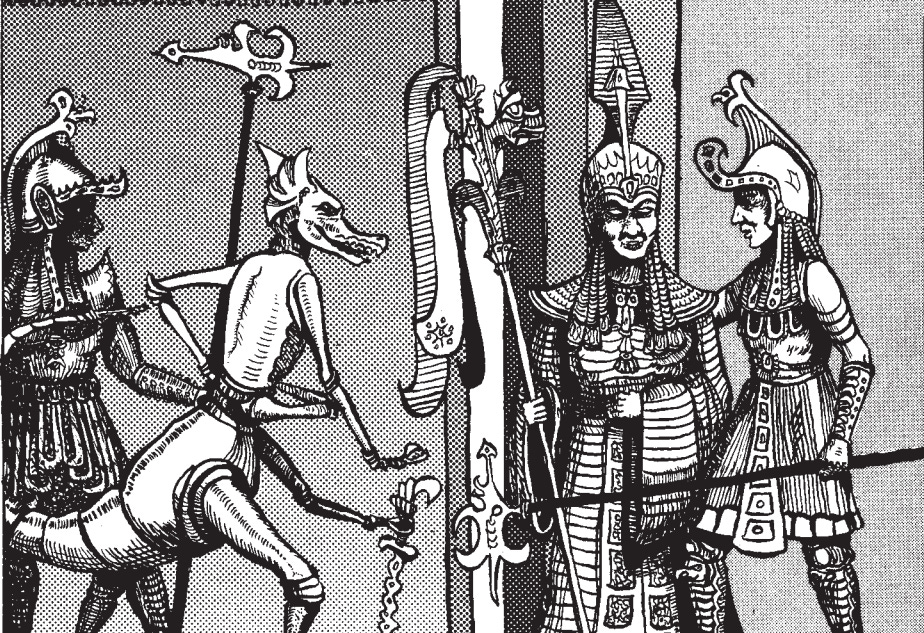
“Anybody here speak bug?”
Languages are mentioned in Knave 2e, but given the “tool-kit” nature of book, no list of languages is given. Below is my WIP list of languages for Knave 2e (along with some ways to use them to give certain items more flavor).
PCs: For each INT a PC has, they know one additional language. All PCs begin knowing Common. PCs can choose their additional languages (but I always encourage rolling!) I’m debating if a training time/cost should be required as well. Perhaps a good use for finding language books?
LANGUAGES
To determine a random language, roll d10 and consult the table below. If you wish to skew the results towards a human language, roll d12 or d20. Any result 10+ is a human language.
ANIMAL: Roll for an Animal (p. 64). Can speak to animals of that type both normal and intelligent (Example: Knowing “Bear”, you can speak to both normal bears and Bear-People).
CHAOTIC: Demons, monsters, cultists, underworld denizens, and evil creatures.
DRACONIC: Dragons, draconians, and other serpents.
DWARVEN: Dwarves, gnomes, constructs, etc.
FAERIE: Changelings, elves, fairies, centaurs, elementals, jinn, satyrs, spirits, and all similar and sufficiently sylvan beings.
GIANT: Giants, cyclops, trolls, and other ancient titans.
GOBLIN: Goblins, ogres, and all beastly humanoids.
LAWFUL: Angels, priests, and goodly beings.
MERFOLK (ATLANTEAN): Merfolk and other underwater people.
(or higher) HUMAN LANGUAGE: See the human languages table.
HUMAN LANGUAGES: Roll a d6, d8, d12, d10, or d20 depending on whether you want Common included as a result and how likely you wish it to be a result. Roll d8, d10 or d12 if you wish to skew the results to the native region.
1. BRETON: Language of the western forests of Bretannia.
2. DRAKARAN: Language of the southern jungles of Drakara.
3. HYPERBOREAN: Language of cold, northern Hyperborea.
4. KISMETIC: Language of the southern deserts of Ur.
5. RARE/DISTANT LANGUAGE: Roll Rare/Distant Below.
6-11 NATIVE: Whatever language is native to the current region.
12-20 COMMON: Language of the Realm and the waning Common Empire.
RARE/DISTANT HUMAN LANGUAGES: Roll d6.
DRUIDIC: Secret language of the Breton druids.
SCYTHIAN: Language of the near-eastern eternal steppe.
THIEVES CAN’T: Secret language of the Thieves Guild.
VINDRIC: Language of the near eastern, tropical Vindra.
XYZ: Language of the far east, unknown, and imperial Xyz.
NON-HUMAN: Roll on the non-human language table.
Ways to use these tables (or similar ones):
Determining what language a Book is written in, or what language (result 50 of the Books table) is being referred to. This of course can include spellbooks and scrolls.
The origin for treasures (p. 42).
Determining the language/culture of any characters as needed.
Because these tables can be rolled with different dice that weigh the results, you can create relatively consistent results that still spark adventure and create fun moments of finding people and items from far off lands.
DESIGNER’S COMMENTARY: The number of languages a PC can know being based off their INT is taken straight from OD&D (where a PC knows one additional language per point above 10 INT). The streamlined non-human language list is not uncommon these days (even 5e’s is pretty simple) but I wanted to group even more together for my specific tastes. Add an Orcish language back to the list if that’s your jam.
As for the human languages, these can easily be replaced with human languages from campaign settings. An example using the World of Greyhawk Box Set:
HUMAN LANGUAGES: Roll a d6, d12, d10, or d20 depending on whether you want Common included as a result and how likely you wish it to be a result. Roll d10 or d12 if you wish to skew the results to the native region.
1. FLAN
2. SUEL
3. OLD OERDIAN
4. ANCIENT BAKLUNISH
5. RARE/DISTANT LANGUAGE: Roll Rare/Distant Below.
6-9 NATIVE: Whatever language is native to the current region.
10-20 COMMON
RARE/DISTANT HUMAN LANGUAGES: Roll d10
DRUIDIC
THIEVES CAN’T: Secret language of the Thieves Guild.
FERREL
NYRONDESE
THE COLD TONGUE
VELONDI
KEOLANDISH
LENDORIAN
(or higher) NON-HUMAN: Roll on the non-human language table.
I enjoy having the “Animal” languages as I love the idea from that in OD&D all creatures can have their own language (see this post for more on that) and also doubles as a way to have PC’s speak the languages of various “Beast Peoples” without me having to keep track of 50 different cat people languages should the need arise.
I should note that while Knave does not have alignment per se, I like the idea of demonic and angelic creatures having their own languages (with Lawful also serving as a liturgical Latin-type language), so I added alignment languages to the game that makes them more like the Celestial/Infernal/Abyssal languages of modern D&D. I figured druidic and Faerie covered the ground for the Neutral language.
As an aside, I found using the terrain types from OSE a good idea to start with when creating fantasy humans (Bretons = Forest people, Common = Clear, Grasslands, Kismetic = Desert, etc.)
Art is from Empire of the Petal Throne.
I've been thinking about languages too. There are brief rules for learning languages in the Downtime section of the rules. I'm a big believer in local dialects, so if my party moves very far from its home base, it's going to have to hire an interpreter.