
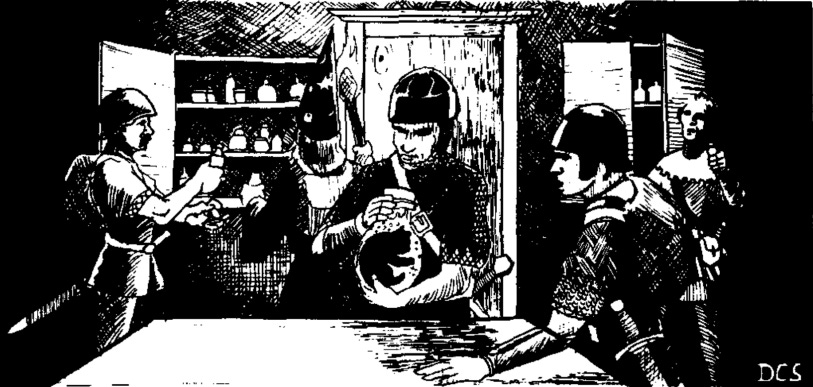
(Image from module “In Search of the Unknown”)
This post will be a long one as it includes new rules for spellcasting, creating new spells, magic items, and so on. Once again these rules and this post is inspired by Knavelands, specifically a post from him about creating magic items that I recommended reading. I have include his rules here with some of my own additions for the sake of completeness, specifically in the “Enchantment” section.
This post will be in nine parts: Spellcasting, Spell Research, Alchemy, Scrolls, Enchantment, Ingredients, Minerals, Crafting, and Designer’s Commentary which talks about why each section is the way it is. All of these rules are additional to the pre-existing Knave rules and exist to offer more options, tools, and goals for PCs.
PART I: Spellcasting
SPELLCASTING
SPELLS: A spell can only be cast once per day. If cast again before the next dawn, the spell is permanently destroyed.
SORCERY: PCs that have cast their INT spells for the day can attempt sorcery to cast more spells by making an INT vs. Spell Level check each time they cast a spell. On a failure, the caster cannot reattempt sorcery that day and they must roll on the magical mishaps table. Sorcery is illegal and punished in most places due to the danger it presents.
WOUNDS: PCs can take wounds to gain a bonus to their sorcery INT check. Each wound gives a +1 to the check. A PC who fails a sorcery INT check that took wounds for it also takes d6 damage equal to the spell level in addition to a roll on the magical mishaps table.
d10 MAGIC MISHAPS
1: Disaster (p. 31)
2: Mutation (p. 30)*
3: Delusion (p. 30)*
4: Effect is Opposite of Intention**
5: Spell Destroyed**
6: Wrong Target**
7: Caster takes d6 x spell LV damage
8: Spell becomes Chaos Spellbook**
9-10: Roll Twice on this table
*2-in-6 chance the mishap happens to target of the spell, not the caster.
**Reroll duplicate results.
PART II: SPELL RESEARCH
SPELL RESEARCH
SPELL RESEARCH: To discover a spell formula, a PC must study in a library of no less than 5 books for four hours (one watch) of time. The subject of each book does not matter, but the PC must note which specific books are being used. The PC then makes an INT check. The PC adds +5 to the check if they spend an additional watch researching in a library with 15 or more additional books. On a success, the PC discovers a formula and rolls on the random spell formula table below to determine what was discovered. On a failure, a PC must find d6 new books or study in a different qualifying library before research can be reattempted.
RANDOM SPELL FORMULA: Roll d4.
1: Spells (pp. 22-25)
2: Spell Formulae (p. 27)
3: Potions (p. 35)
4: Powers (p. 65)SPELLCRAFT: Once a formula is found, crafting a spell requires a laboratory, a blank book (tablets or other similar mediums can suffice), ingredients, and four hours (one watch) of time. The player describes the effect and duration of the spell they are trying to make, along with the ingredients to be used (usually monster parts, but in theory any rare substances with the right properties could be used). If the GM approves the spell, the PC makes an INT check. The PC adds +5 to the check if they spend an additional watch crafting. On a success, the spell is created. If the PC fails this check with a roll of 1, a chaos spellbook is created instead. The ingredients are lost no matter the outcome. If the PC succeeds at the check by 10 or more, they have mastered crafting that spell and no longer need to make a crafting check to make it when using those exact ingredients.
OTHER INGREDIENTS: Potions, magic items, and spells with the same or very similar effects can be used as spellbook ingredients. Using such pre-made ingredients adds one additional watch of time as they are disenchanted. PCs can also use the blessing of a patron with a relevant domain to the effect of the spell.
PART III: ALCHEMY
ALCHEMY
OILS AND BOMBS: PCs can choose to instead make oils that are applied directly to a target or bombs that can be thrown.
APPLYING POISON: Poison oils can be applied to an item safely in one turn. Applying poison to an item during a combat round requires a DEX check to avoid poisoning.
FOOD: Can be created with potion effects if they have the right ingredients.
POTION MISCIBILITY: If two potions are mixed, or a potion is drunk while the effects of another are ongoing, roll below.
d100 POTION MISCIBILITY
1: EXPLOSION! Deals 4d6 damage within 10’. If mixed internally the explosion kills the drinker.
2-3: Lethal Poison: Kills the drinker
4-6: Mild Poison: Deals d6 damage.
7-10: Transmutation: The mixed potions transform into a random Element (p. 29).
11-15: Wild Magic: a new potion results with a random Effect (p. 28).
16-20: Immiscible: The effects of both potions are cancelled.
21-25: Immiscible: The effect of one potion is cancelled.
26-35: Immiscible: The effects of both potions are halved.
36-90: Miscible: The effects of both potions work normally.
91-99: Miscible: The effects of both potions are doubled.
00: DISCOVERY! The effect of one potion is now permanent, the other is cancelled.
PART IV: SCROLLS
SCROLL EFFECTS: Scrolls allow a one-time use of a spell at a fixed Spell Level. Spell scrolls can be cast by any character, regardless of their INT, and don’t count towards their spell limit for the day.
SCRIBING: Scribing a spell requires a blank scroll, a writing station, ingredients, the spellbook that the scroll is being made of, and four hours (one watch) of time. The PC can make the Spell Level of the scroll their INT or less. The ingredients used for the scroll ink must have similar properties to the effect of the spell. If the GM approves the ingredients, the PC makes an INT check against the scrolls Spell Level. The PC adds +5 to the check if they spend an additional watch scribing. On a success, a scroll is created. If the check is failed by 10 or more, a cursed scroll is made (see below) Any ingredients are lost regardless of the outcome, but the spellbook itself is only lost if the check is failed. If the PC succeeds at the check by 10 or more, they have created a recipe for that scroll and no longer need to make a check to make it when using those exact ingredients at that Spell Level or lower.
D6 CURSED SCROLL EFFECTS
1: Disaster (p. 31)
2: Mutation (p. 30)*
3: Delusion (p. 30)*
4: Effect is Opposite of Intention.
5: Works, But Always Wrong Target
6: Caster takes d6 x spell LV damage.
*2-in-6 chance the curse effects the target of the spell, not the caster.
PART V: ENCHANTMENT
ENCHANTMENT
Enchanting an item requires the item one desires enchanted, ingredients, the appropriate workshop/tools for the item, the relevant career(s) for crafting such an item (blacksmith, mason, etc.) and four hours (one watch) of time. The player describes the effect and duration of the enchantment, along with the ingredients to be used (usually monster parts, but in theory any rare substances with the right properties could be used). If the GM approves the effect, the PC makes an INT check (if making a melee weapon, use STR. If making a missile weapon, use WIS). The PC adds +5 to the check if they spend an additional watch crafting. Each enchantment or blessing an item already has gives this check a -5. On a success, the enchanted item is crafted. If the roll is failed by 5 or less under the target number, the item is created but is cursed (see below). A failure by 6 or more destroys the item. Ingredients are lost no matter the outcome. If the PC succeeds at the check by 10 or more, they have created a recipe for that item and no longer need to make a crafting check to make it when using those exact ingredients.
D6 CURSED ITEM EFFECTS
1-3: Mutation (p. 30)
4-6: Delusion (p. 30)OTHER INGREDIENTS: Potions, magic items, and spells with the same or very similar effects can be used as item ingredients. Using such pre-made ingredients adds one additional watch of time as they are disenchanted. PCs can also use the blessing of a patron with a relevant domain to the effect of the item.
REPAIRING ITEMS: Follows the same process and requires the same or very similar ingredients used to create the item to repair it. An item can be reforged with other ingredients, but the original power of the item will be lost.
EFFECT DURATION: An item that is meant to be used more than once may require additional ingredients. How long the effect will last and how many times the item can be used will be balanced by GM and the effect.
MAGIC ARMOR: PCs only gain a magic AC bonus from the armor piece that gives them the highest AP bonus. Shields are excluded from this restriction and can offer their own additional AP bonuses. PCs still gain the normal +1 AP from their other armor pieces.
PART VI: INGREDIENTS
INGREDIENTS
HARVESTING: PCs can spend a watch to search for an ingredient. If searching in a barren landscape or for a specific ingredient, PCs must make a WIS check. Failure when looking for a specific ingredient will still result in finding an ingredient of some sort, A failure in a barren area results in nothing being found.
SPECIAL INGREDIENTS: Use the following to determine what special ingredient is found.
1. Roll the plant Effect (p. 28).
2. If an ingredient with that effect already exists for that region, there is a 5-in-6 chance that’s what’s found. Otherwise, go to step 3.
3. Roll the Color (p. 37) and d10 for the form of the ingredient.
d10 INGREDIENT FORM
1: Fruit
2: Vegetable
3: Root
4: Mushroom
5: Shrub/Weed
6: Moss
7: Flower
8: Tree
9: Crawling Insect
10: Flying InsectINGREDIENT EFFECTS: Ingredients must be prepared in a potion or some other method to unlock their full magical properties. Some ingredients may have extremely weak effects when consumed, typically lasting 1 round.
PRESERVATION: PCs can spend a watch in the appropriate workshop to preserve perishable ingredients for d6 years. Such ingredients must be stored safely in a building or other such environment.
PART VII: MINERALS
MINERALS
MINING OPERATIONS: These should instead be tracked using the “running a business” rule of the Buildings section of Knave 2e.
EXCAVATING: One can mine four 5’ squares with a 10’ ceiling per watch. A PC with a relevant career or relevant non-human type ( such as dwarves) can mine two squares per watch. 6 workers can all fit in the one 5’ square.
1. Start by rolling on the Rocks table to determine what is mined.
2. The GM rolls in secret how many 5’ squares of the material are found. Every square gives one item slot of material. (1 5’ square = 1 item slot of mineral).
3. The GM rolls direction for each 4 squares of a found deposit in secret on the deposit direction table.
D6 ROCKS
1: Granite
2: Shale
3: Limestone
4: Chalk
5: Sandstone
6: Roll on the Other Minerals TableD10 OTHER MINERALS
1: Volcanic (Concrete Grade)
2: Mercury
3: Sulphur
4: Tin
5: Zinc
6: Lead
7: Coal
8: Porcelain Clay
9: Petroleum
10: Roll on the Semi Precious Minerals TableD10 SEMI PRECIOUS MINERALS
1: Copper
2: Iron
3: Quartz
4: Meteorite
5: Carnelian
6: Jasper
7: Marble
8: Nitre
9: Aluminum
10: Roll on the Precious Minerals TableD10 PRECIOUS MINERALS
1: Orichalcum
2: Ophite
3: Silver
4: Gold
5: Electrum
6: Platinum
7: Mithril
8: Adamantine
9: Color (p. 37) + Effect (p. 28)
10: Gems - see Materials (p. 42)D10 DEPOSIT SIZE IN 5’ SQUARES
1: 1
2: d2
3: 2
4: d3
5: d4
6: d6
7: d10
8: d12
9: 2d6
10: d6 x 2d6D8 DEPOSIT DIRECTION
1: Steep descent
2: Shallow descent
3: Curves right
4: Curves left
5-6: Continues Straight
7: Shallow Ascent
8: Steep Ascent
PART VIII: Crafting
CRAFTING
Crafting a mundane item requires a relevant career, half the base cost of the item (unless the PC already has the right components such as iron + leather to craft an iron sword), the appropriate tools, a workstation, and four hours (one watch) of time. The PC then makes a relevant check (typically with INT, although STR is used to forge melee weapons and WIS to craft missile weapons). The PC adds +5 to the check if they spend an additional watch crafting. On a success, the item is crafted. The parts are lost no matter the outcome. If the PC succeeds at the check by 10 or more, they have created a recipe for that item and no longer need to make a crafting check to make that exact item with the same ingredients.
REPAIRING ITEMS: Follows the same process as crafting and requires the same or very similar ingredients used to create the item to repair it (or 1/3 the base item cost).
PART IX: DESIGNER’S COMMENTARY
Congrats on making it this far.
SPELLCASTING: The rules for sorcery are of course taken from/inspired by Dungeon Crawl Classics and some early Knave 2e playtest documents. I wanted a form of “forbidden magic” that did not replace the Knave 2e magic rules nor made spells too overpowered. Additionally, I wanted to put the great Disaster, Mutation, and Delusion tables to use. I figured a fairly dangerous magic mishap table would do the trick.
SPELL RESEARCH: These are probably the rules I’m most happy with. It means a PC will have to collect many types of books in order to learn how to make various spells, contributing to the fantasy of a wizard with a large library of various books (and gives the book table in Knave even more use.) Additionally, not being able to choose what formula the PC ends up learning feels right as a wizard uncovers various esoteric spell formulas in an attempt to learn one that is useful to them. It also gives another possible source for where chaos spellbooks come from besides the spellcasting magical mishap table.
ALCHEMY: The idea for oils and bombs came from the new edition of Durf, the idea for food with potion effects was probably inspired by Dungeon Meshi, and the Potion Miscibility table comes from earlier playtest versions of Knave 2e, which Ben Milton in turn took from AD&D.
SCROLLS: Knave 2e mentions spell scrolls in a few places but I compiled the rules together in their own section here. I saw the possibility of creating cursed scrolls as a chance to once again use the delusion, mutation, and disaster tables.
ENCHANTMENT: As I mentioned before, Knavelands heavily inspired many of the magical crafting rules, with most of the ideas here being variations on his transformation of the Knave 2e alchemy rules. Having the correct careers is very important to enchanting an item, which feels right to me. The rule on magic armor actually comes from a suggestion Ben Milton gave me via a short email exchange where I asked him the best way to handle armor with magic AC bonuses in Knave.
INGREDIENTS: Knave 2e mentions plants and other non-monster ingredients as a possibility but does not go into further detail. I know there are other books that do this, but I wanted a simple procedure to make up various types of magical ingredients that don’t come from slaughtering monsters. I figure each (or at least most) hexes can have some magic ingredient somewhere on it.
MINERALS: All I know of mining comes from half-remembered museum visits, minimal research, and playing Minecraft and Skyrim. That is to say, I don’t really know anything about mining. What I do know is that I wanted something on standby if PCs started digging holes in the ground that also allowed for the creation of magical ores (such as the effect + color result). These rules are 95% those from the Judge Guild Ready Reference Sheets, 4% AD&D mining rules, and 1% kludging by myself. Such minerals could be sold using the price guidelines of the equipment section or used as ingredients which is why I included it here.
CRAFTING: I have actually organized these rules into my Downtime section additions but I figured they were worth adding to this post seeing as crafting is a reoccurring theme throughout the various procedures. Besides, PCs can use these rules to craft items to enchant or possibly act as ingredients.
And that’s that. I thought about writing each of these parts as separate posts but figured they all work better in concert with one another since they all tie together in one way or another. I’m not sure what I will post next, but it will likely either be a few additional rules for PC creation and leveling or some additions/clarifications to the Building rules. Either way, expect something shorter next time.
Thanks for reading!